Singapore's DC-CFA Is Not a Tender. It Is a Geopolitical Filter.
DC-CFA1 looked like a tender. The criteria, the language, and the four winning profiles tell a different story.

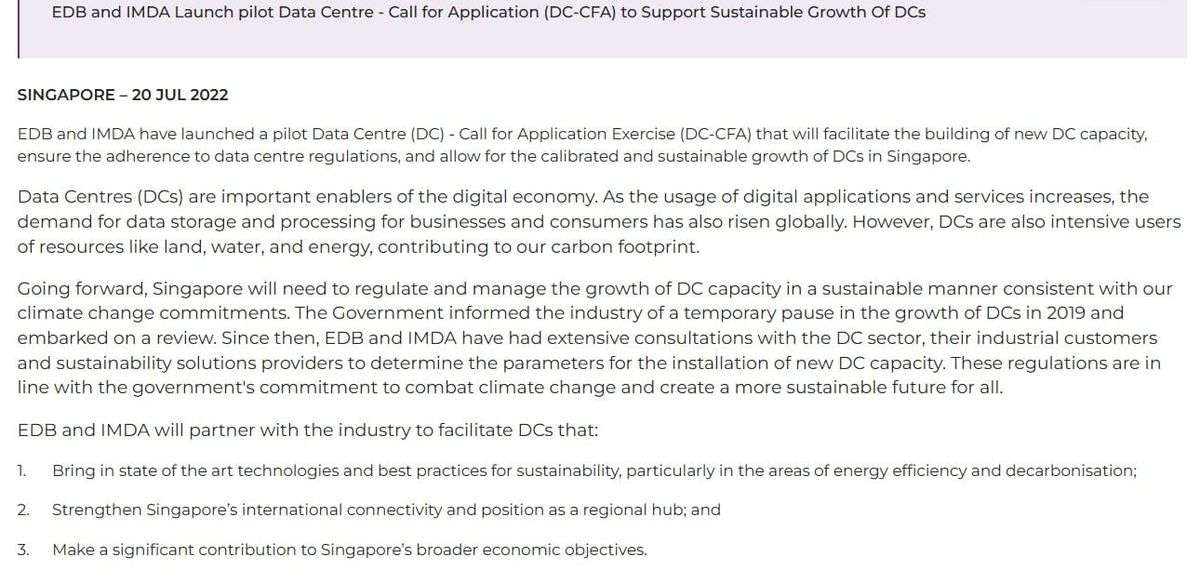
"Given the quality of the proposals received, we are provisionally awarding about 80 MW to the following companies (listed alphabetically): AirTrunk-ByteDance, Equinix, GDS, Microsoft." - IMDA, July 2023.
One word in this sentence deserves attention: provisionally. IMDA reserved the right to revise after announcement. The award was not final.
The list is silent on Digital Realty, a Singapore incumbent with three operational facilities. IMDA never confirmed the rejection. Data Center Dynamics did.
Their proposal was not weak. Digital Realty had partnered with CoolestDC, a National University of Singapore spinoff, applying custom cooling plate technology already piloted at an existing Singapore facility. Local partnership. Existing presence. 60MW project.
They did not win.
No public explanation. No official comment.
I spent time reading the primary documents to understand the logic behind the four selections. The answer is not in the press release. IMDA named no losers and gave no individual feedback. It lies between the lines in the selection criteria and in the pattern they reveal.
What 'good enough' means and what Singapore's process actually selects is the question worth asking now, as DC-CFA2 closes on March 31, 2026.
Meeting desired outcomes of DC-CFA
By publishing a press release in July 2023, IMDA provides some insights on why AirTrunk-ByteDance, Equinix, GDS and Microsoft were selected from more than 20 proposals for DC-CFA1, launched in July 2022. It gives some idea of the direction things are heading and what IMDA values.
Annex A of the DC-CFA1 launch set three formal evaluation criteria: sustainability through best-in-class energy efficiency, strategic value through connectivity, and economic contribution to Singapore's broader objectives.
The July 2023 winners announcement described what the four selected proposals actually delivered. They deserve careful reading. Four highlights reveal what meeting those criteria meant in practice:
- The best-in-class liquid cooling with Green Mark DC Platinum Certification was required. It ensures that Singapore remains at the forefront of energy efficiency. Whether the partnership between Digital Realty and Singapore-located CoolestDC with proven expertise thermal engineering met the bar is not public. But the proposal was not technically weak.
- The submarine cable capacity and new carrier neutral exchanges can be considered as infrastructure that goes beyond the data center. This is an investment in Singapore’s geopolitical connectivity position. Not just in its own operations.
- Anchoring AI/ML compute and High-Performance Compute in Singapore was not part of Annex A. It did not appear in the 2022 tender. It appeared in the 2023 winners announcement, as a priority IMDA added between the call and the decision. The winner is not just a builder. It is entitled to position Singapore as an AI hub. Simple data center capacity is not sufficient.
- "Significant economic commitments to Singapore beyond the direct DC investments." This commitment has no measurable definition. It is discretionary by design and gives IMDA maximum flexibility in selecting partners, and maximum negotiating leverage over applicants.
The four escalate from technical to geopolitical to strategic to discretionary. The first filters out weak proposals. The fourth determines who wins.
This is a structural advantage derived from strategic fit, not from technical superiority. With DC-CFA, Singapore has created a tool that does not allocate data center capacity. It selects geopolitical partners. Those who secure capacity in Singapore are not necessarily the best builders. Those who most convincingly demonstrate how their data center completes Singapore's strategic stack.
The fourth commitment has no measurable definition. This is deliberate. No applicant can benchmark themselves against a definition that does not exist. The operators best positioned to win it are those who already know what IMDA means by "significant economic commitments" before the application opens.
How that knowledge is built is not in the public record. The most plausible mechanism: sustained engagement with EDB and IMDA, participation in industry working groups, prior involvement in Singapore's digital economy framework. This is inference from structure, not evidence from the documents. But the structural logic holds independently: if the definition is discretionary, the advantage belongs to whoever has the prior relationship.
At least one winner had a profile that aligned with Singapore's stated priorities in a way that is publicly visible. Months before the DC-CFA1 decision in July 2023, Microsoft opened Asia's first Datacenter Academy in Singapore training 300 ITE students. What the others specifically committed to is not public. IMDA didn't name details per operator.
What Digital Realty specifically proposed beyond CoolestDC is not public.
| Operator | Existing SG Presence | Public Evidence |
|---|---|---|
| Microsoft | Yes, 3 facilities | Datacenter Academy for 300 students, opened Jan 2023 |
| Equinix | Yes, 5 facilities | $260M SG6 investment; NUS research collaboration on alternative power; IMDA/Dell policy guidance; Sembcorp renewable PPA; 268-facility global interconnection network; Largest existing DC footprint among winners |
| GDS | No | International HQ established in Singapore 2022, before DC-CFA1 award |
| AirTrunk-ByteDance | Yes, 1 facility | Formal consortium with ByteDance |
The table reveals a pattern. Three of four cases documented from primary sources.
Microsoft anchored Singapore's position in the Western hyperscaler stack through talent: 300 ITE students trained at Asia's first Datacenter Academy, opened before the DC-CFA1 award.
According to an official announcement of EDB, Equinix committed $260 million to SG6, collaborated with NUS on alternative power supply research, developed sustainability guidance with IMDA and Dell Technologies, and connected Singapore to its 268-facility global network.
DayOne (formerly GDS International) established its international headquarters in Singapore in 2021. EDB confirmed that the DC-CFA award enabled the development of DayOne's facility as "the flagship site anchoring the successful execution of the SIJORI regional strategy" — Singapore, Johor, and Riau Islands as a connected regional ecosystem. The economic contribution was threefold: a 10-year renewable energy PPA with Sembcorp, an NUS research partnership under the Sustainable Tropical Data Center Testbed 2.0 to advance cooling innovation in tropical climates, and Singapore's first on-site SOFC proof-of-concept for hydrogen-based energy generation. DayOne CEO Jamie Khoo: "This facility marks our commitment to Singapore as both home base and regional hub while highlighting our long-term vision to power Southeast Asia's digital transformation with green infrastructure." In another announcement Khoo added: "Singapore's leadership in digital innovation strengthens GDS International's ability to serve global customers from this vital location."
What AirTrunk-ByteDance specifically committed to beyond the formal consortium structure is not in the public record.
Three of four winning profiles are documented. Each filled a different role. Singapore did not select the four most technically qualified operators. It selected four operators not for what the criteria can measure, but for what no criteria can mandate.
This is inference from the pattern, not from IMDA's internal deliberations. But the structural logic is consistent across three cases.
How can Singapore afford to set the bar so high?
Singapore is one of the most expensive data center markets in the world. Energy costs are high. Cooling in tropical heat adds further pressure. DC-CFA requirements add compliance costs that have no equivalent in neighboring markets.
| Market | Price per kW/month | Source |
|---|---|---|
| Singapore | $310–$470 | CBRE, 2025 |
| Global weighted average | $217 | CBRE Q1 2025 |
| North America average | $196 | CBRE H2 2025 |
| Atlanta (lowest US market) | $160–$180 | CBRE, 2025 |
And yet: more than 20 operators submitted proposals for 80MW in DC-CFA1. The demand was not despite the constraints. It was partly because of them.
Scarcity is the product. Singapore engineered it deliberately.
DC-CFA2: Same Logic, Higher Bar
DC-CFA2 has the same structure but even more stringent requirements. The pattern observed in DC-CFA1 suggests that the winner is not the one who builds most efficiently, but the one who most convincingly demonstrates how their data center advances Singapore’s geopolitical and economic goals.
DC-CFA1 had no explicit green energy requirement in percentage terms. DC-CFA2 requires at least 50% from a specific list of approved technologies: biomethane, low-carbon ammonia, low-carbon hydrogen, novel fuel cells with carbon capture, or building-integrated photovoltaics. Renewable Energy Certificates do not qualify.
This is a structural shift. Winning in 2023 required technology, connectivity, and strategic fit. Winning in 2026 requires all three plus a credible green energy supply from a narrow technology list. In a city-state with no meaningful renewable energy sources of its own.
That constraint is not trivial. Singapore cannot generate the required green energy domestically at scale. Whoever wins DC-CFA2 will need either a contracted supply of biomethane or hydrogen or a genuinely innovative on-site solution. These are markets that are still nascent in Southeast Asia. That is a real infrastructure problem, not a paperwork problem.
The strategic and economic criteria have the same structure as DC-CFA1 but the language has tightened. DC-CFA1 asked applicants to "strengthen Singapore's position as a regional hub." DC-CFA2 asks them to strengthen Singapore's position as a "trusted hub for AI and DC investments" with explicit reference to infrastructure resilience and international connectivity. The word trusted is new. It is not accidental.
On the economic side, DC-CFA2 now asks for fixed asset investment figures and total business expenditure. Specific numbers are requested, not general commitments. And it asks explicitly for partnerships that "improve the competitiveness of industries and companies based in Singapore." That is a requirement to demonstrate local economic impact beyond the data center fence.
The pattern from DC-CFA1 holds. But the discretionary fourth criterion now has more surface area. More ways to differentiate, and more ways to fall short.
The Real Competition
Read the criteria, the language, and the discretionary fourth filter, and a different process emerges.
The form is procurement. The function is geopolitical selection.
Operators who treat it as a procurement exercise have likely already lost. No matter how much technical competence or financial capital they bring. DC-CFA2 is a geopolitical filter, not a technical competition.
Capital and technical competence matter. They are the baseline, not the clincher. The actual winners are those who fill the gaps Singapore cannot fill itself, and offer utility the city-state cannot generate domestically. That decisive criterion cannot be benchmarked.
DC-CFA2 results will be announced later in 2026. DC-CFA1 selected four winners with different profiles: Microsoft as a hyperscaler, Equinix as a global colocation leader, GDS as a Chinese colocation operator, and AirTrunk-ByteDance as a consortium with Chinese tech participation. The pattern was diversity by strategic profile, not concentration by scale.
If the discretionary fourth criterion remains decisive in DC-CFA2, the pattern will repeat. At least one winner will not be among the top ten global colocation operators by capacity. At least one will be Chinese or Chinese-linked again.
Watch who wins. Watch what gap they filled.
Note: Published the day DC-CFA2 closed.